
From AI Pilots to Production
Why most enterprise AI stalls at the proof-of-concept ceiling, and the operating model that finally ships it.
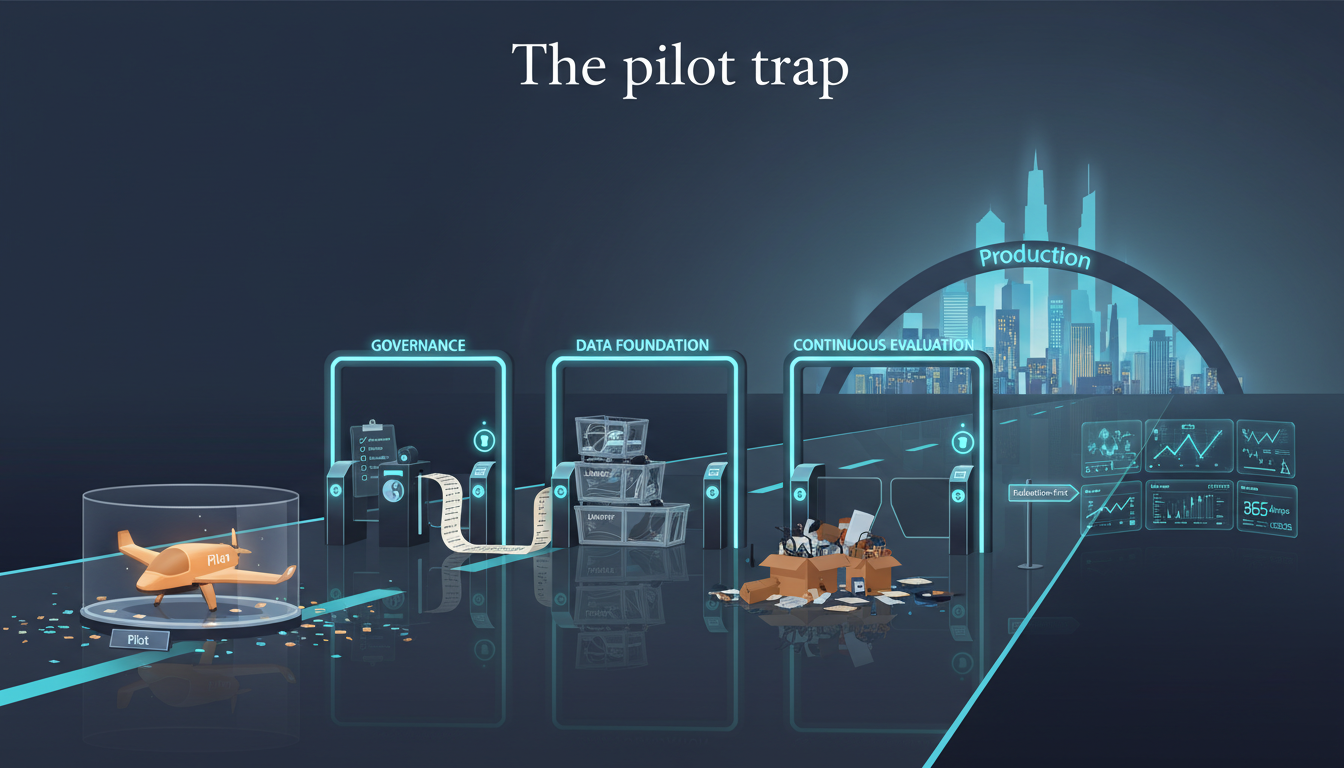
The pilot trap
Most enterprise AI never leaves the lab. A model demos well, leadership applauds, and then it dies in the gap between a notebook and a governed production system. The proof of concept was never the hard part. A capable team can stand up an impressive demo in a few weeks. The hard part is everything the demo was allowed to skip: the data that has to be trustworthy every day instead of once, the failure mode that is charming in a sandbox and unacceptable in front of a customer, the approval that no one needed until real money started moving through the system.
So the pilot stalls at a ceiling. It is too good to kill and not safe to ship, and it joins the quiet graveyard of slides that once got a standing ovation.
What actually changes between a pilot and production
Three things change, and each one is a reason a pilot that worked stops working.
Governance moves from afterthought to gating item. In a pilot, governance is a box you promise to check later. In production it is the thing standing between you and launch, and rightly so. Who is accountable when the model is wrong? What is the human review step for a high-stakes decision? Where is the audit trail when a regulator, a customer, or your own legal team asks why the system did what it did? A pilot that cannot answer those questions does not get a waiver in production. It gets sent back.
Data has to be inventoried, accessible, and auditable. The demo ran on a clean extract someone pulled by hand. Production runs on live data that arrives late, contradicts itself, and changes shape without warning. Before the model is the problem, the data is. You need to know what you have, where it lives, who is allowed to see it, and whether you can prove its lineage. Most pilots that die in production die right here, on a data foundation that was never built to carry daily weight.
Evaluation becomes continuous, not a one-time benchmark. A pilot is judged once, on a fixed test set, on a good day. Production is judged every hour, on inputs no one anticipated, while the world it was trained on drifts underneath it. A model that scored ninety-five percent in the demo can quietly degrade to something harmful three months later, and without continuous evaluation you will hear about it from a customer, not from a chart.
We ship evaluation-first, not model-first.
That sentence is the whole philosophy. The first artifact we build is not the model. It is the evaluation: the concrete definition of what good looks like, the test sets that represent real and adversarial inputs, and the monitoring that runs the moment the system goes live. The model is then chosen and tuned to clear that bar, and to keep clearing it. Model-first teams fall in love with a demo. Evaluation-first teams build something the business can rely on, because they defined "reliable" before they wrote a line of it.
The operating model that ships it
The missing piece in most stalled programs is not a better model. It is a person. AI in production needs an embedded technical product manager who owns the KPI, not the backlog. Not a coordinator who moves tickets, but a practitioner who is accountable for the business result the system was funded to produce, with the technical depth to argue with the data scientists and the standing to say no to a launch that has not earned it.
This is the operating model our Data and AI practice runs. We embed that owner inside your team, alongside your engineers and your domain experts, and we make them responsible for the metric rather than the milestone. They hold the evaluation bar. They raise the governance question early instead of at the finish line. They are the reason the pilot does not become one more ovation that goes nowhere. When the engagement ends, that capability stays with your team, because we built it into how you work rather than into a deck.
That is the difference between a pilot and a capability your business can actually rely on. A pilot proves the model can work once. Production proves the organization can run it every day, see it the moment it slips, and answer for it when it matters.
If you have a pilot stuck at that ceiling, a discovery call is the fastest way to find the specific thing holding it back. You can start one at summittechpartners.com/discovery.
Ready to put this into practice?
Talk to a Summit practitioner, or explore how we deliver.